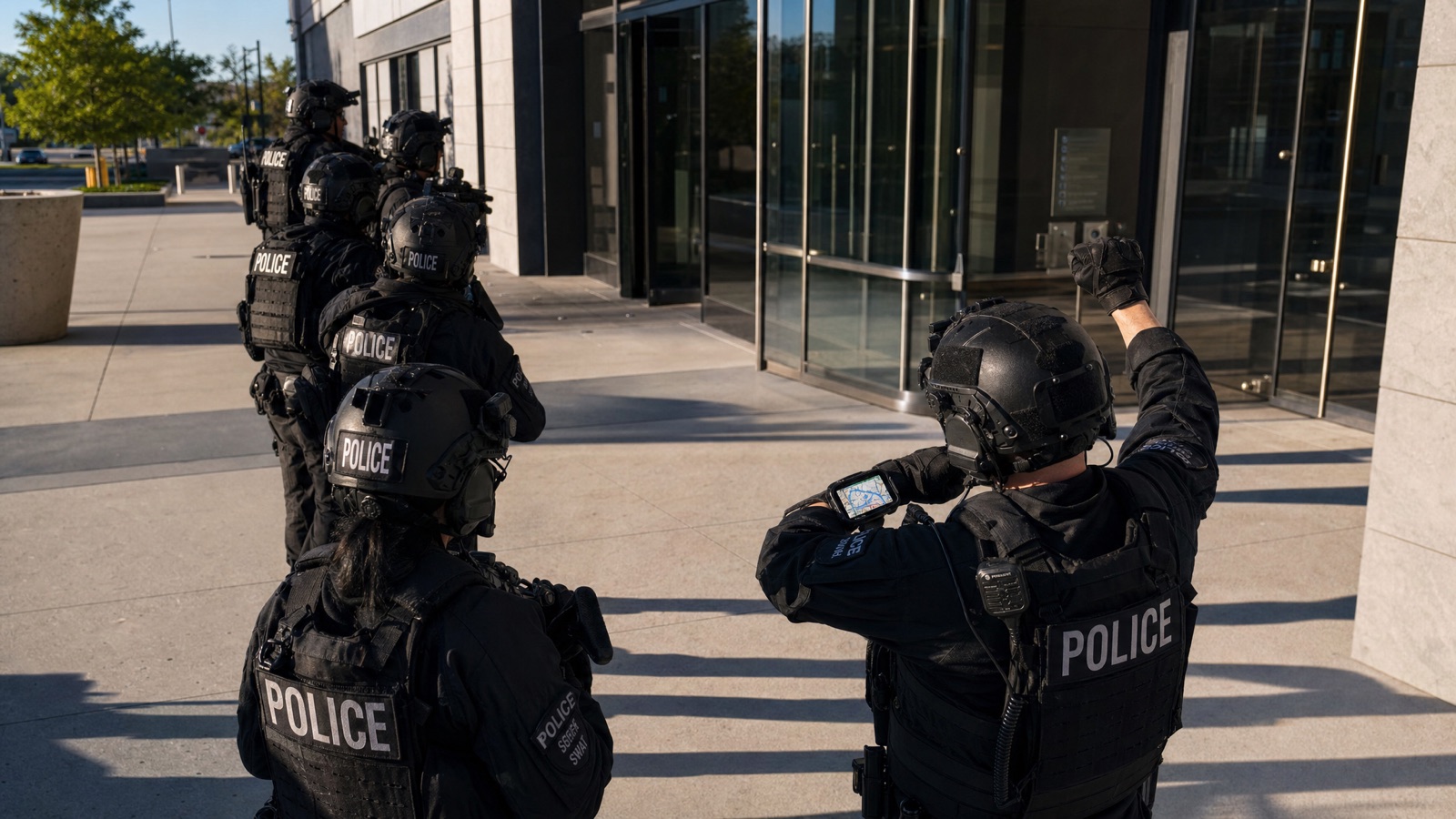
Use Case · LEO & First Responders

Coordinate the response on one live map

Track every unit, coordinate an incident, and keep talking when the cellular network is saturated or down. TAK server, mesh, a field server, and an optional satellite uplink — situational awareness for law enforcement and first responders that does not depend on the public network.

The problem

The cell network fails exactly when you need it

At a large incident, cellular capacity saturates, buildings block coverage, and radio traffic overwhelms a single channel. Command cannot see where units are, and mutual-aid partners run different systems. MAGK gives every responder the same live map over its own network, hosted on a field server that rolls up to the scene.

What you can do

What the response gets

Unit tracking

See every unit in real time

Officer and apparatus positions on one shared map from any TAK client, so command always knows who is where without a radio roll call.

  • Live unit positions across the whole response
  • Mark hazards, staging, perimeters, and points of interest
  • Standard CoT — interoperates with mutual-aid TAK users
  • Runs on the phones and tablets responders already carry

Incident coordination

Run the incident from a shared picture

Draw perimeters and zones, assign areas to units, and scope sensitive information to the groups that need it, so a multi-agency response works from one picture.

  • Perimeters, zones, and assignments on the shared map
  • Group-scoped visibility across agencies and roles
  • Updates reach every unit as the incident develops
  • Attach photos and detail to a located marker

Comms

Talk when the network is down

Text and voice ride the MAGK Net mesh, independent of the cellular network, so responders stay in contact through saturation, dead zones, and outages.

  • Text and voice with no cellular dependency
  • Group-scoped channels by agency, unit, or task
  • Messages queue in dead zones and send on reconnect
  • Coverage extends as responders and vehicles spread out

Field server & uplink

Rolls up to the scene

A field server hosts the TAK server at the incident, so the picture works with no internet. Add a satellite uplink for an EOC or off-scene command, and an uplink drop never interrupts responders on scene.

  • Full picture and comms with no uplink present
  • Clients associate to the field server over MAGK Net
  • Optional satellite uplink for off-scene command
  • Uplink loss does not degrade the on-scene picture

How it connects

TAK, Net, and Devices working together

The shared picture, the connection that carries it, and the kit that runs it in the field.

  1. MAGK TAK

    The shared picture

    TAK server and client. Unit positions, perimeters, assignments, and group-scoped visibility, spoken over standard Cursor on Target.

  2. MAGK Net

    The connection

    Mesh radio that carries the picture, text, and voice when the cellular network is saturated or down.

  3. MAGK Devices

    The field kit

    Field server and end-user hardware. Hosts TAK at the incident and links responders into the mesh, with an optional satellite uplink.

Responders connect to the field server over MAGK Net. The server hosts TAK at the scene, so the response keeps a live picture with no internet. A satellite uplink links an EOC when present; when it drops, on-scene coordination carries on uninterrupted.

Bring the picture to the response

Talk through the field server, mesh, and uplink that fit your agency, or explore the product family.